
Derailment Is Not Failure (It’s the Skill We Never Learn)
Let’s get something straight right away:
Everyone gets derailed.
Missed workouts. Broken routines. Busy weeks. Low energy. Travel. Stress. Family demands. Seasons of life that don’t cooperate with your plan.
That’s not failure. That’s being human.
What is holding people back isn’t the derailment itself — it’s the belief that progress only counts when conditions are perfect.
The Real Problem Isn’t Motivation
Most people will tell you they “know what to do.”
And they’re right.
Information is not the issue. Discipline isn’t even the issue.
The real gap is this:
What do you do in the moment when your plan breaks down?
Most people fall into one of two traps:
- They try to push through anyway — forcing a hard workout when they’re exhausted, overwhelmed, or under‑prepared
- Or they mentally write the whole week off and promise to “start fresh” later
Both approaches usually end the same way: frustration, inconsistency, and eventually disengagement.
Progress Dies in All‑or‑Nothing Thinking
Here’s the reframe I want you to sit with:
Progress doesn’t die in chaos.
Progress dies when chaos convinces you that nothing counts unless everything counts.
That mindset turns a missed workout into a missed week.
A tough day into a lost month.
A busy season into “I’ve fallen off again.”
That’s not a willpower problem — that’s a strategy problem.
The Skill That Actually Matters: Minimum Wins
The most important skill in long‑term health and fitness isn’t grinding harder.
It’s learning how to stay engaged when things aren’t ideal.
That means asking a different question:
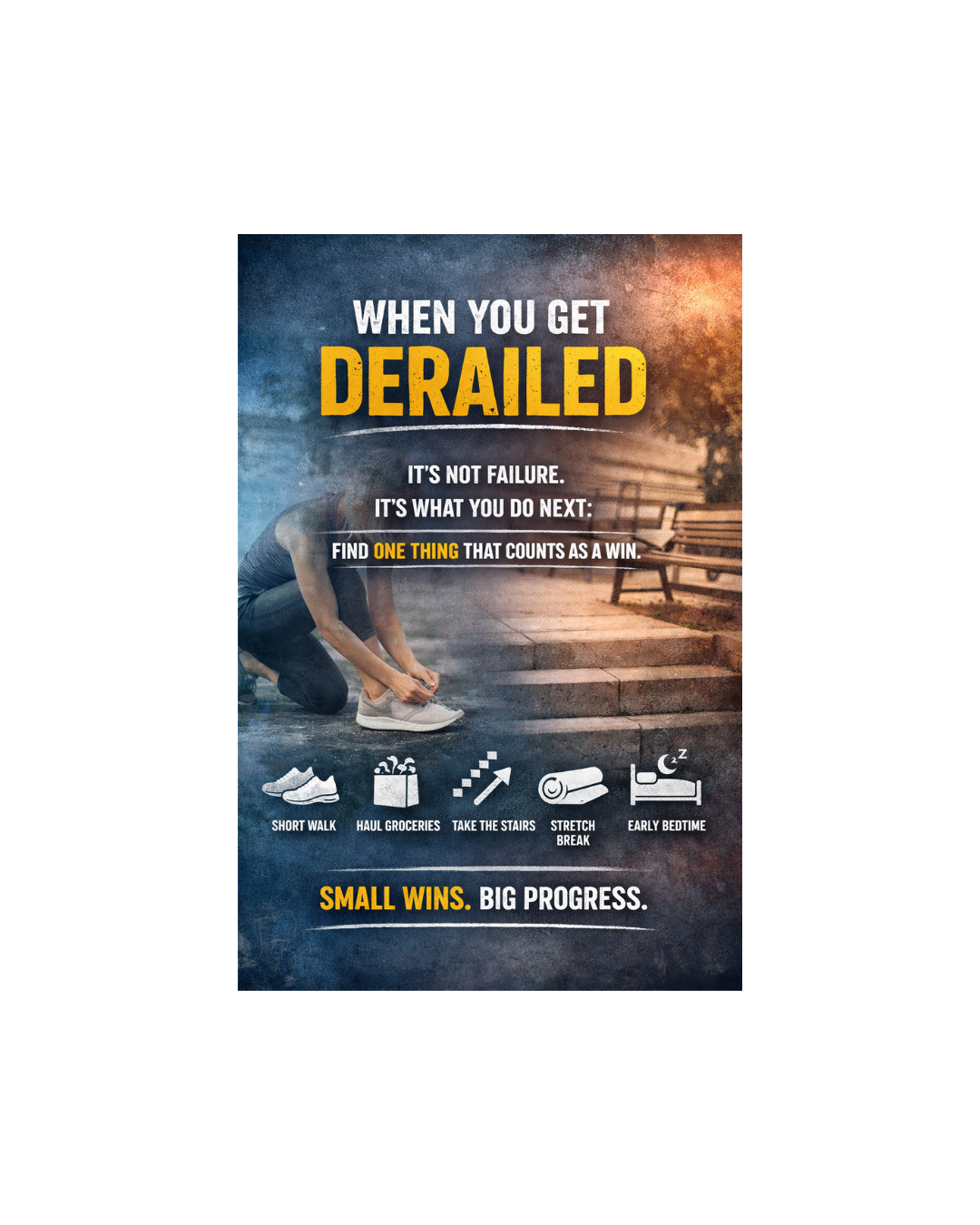
When things are messy, what’s one thing I can do that still counts as a win?
Not perfect.
Not the full plan.
Not Instagram‑worthy.
One stabilizing action that keeps you from dropping the ball completely.
Intentional Movement Still Counts
We dramatically under‑credit the movement we do manage to get when life is full.
Intentional movement might look like:
- A walk instead of a workout
- Carrying groceries or kids
- Taking the stairs instead of the elevator
- Ten minutes of mobility on the floor while dinner cooks
- Choosing to move rather than collapse into the couch
These aren’t consolation prizes.
They’re continuity tools.
They keep the habit alive.
They keep your identity intact.
They keep you in the game.
Why This Matters for the 250 Sessions
This is exactly why the 250 Training Sessions challenge exists.
Not because anyone is expected to train perfectly.
But because over a year, life will interrupt you — and the people who succeed aren’t the ones who never miss.
They’re the ones who know how to respond when they do.
They know how to adjust without quitting.
They know how to recognize progress that doesn’t look like a perfect gym session.
They know how to stack wins instead of starting over.
Redefining Success (Without Lowering the Bar)
This isn’t about lowering standards.
It’s about changing the definition of success in hard moments so you don’t sabotage long‑term progress.
The goal isn’t perfection.
The goal is continuity.
And continuity is built by learning how to say:
“This isn’t ideal — but this still counts.”
A Question Worth Asking Yourself
Instead of asking:
“Why can’t I stay consistent?”
Try asking:
“What’s my minimum win when things go sideways?”
If you don’t define that ahead of time, stress will define it for you — and stress is terrible at decision‑making.
This is the work.
Not grinding harder.
Not waiting for motivation.
Learning how to stay engaged when life isn’t cooperating.
That’s how strength is built — physically and mentally.

.png)


